How crash games work: the multiplier, the crash point and the maths
Every crash game, from Aviator to Stake's original, runs on the same three ideas: a curve that rises, a crash point fixed before the round starts, and a house edge baked into the distribution. This is how all three actually work.

Updated 20 October 2026 · Fact-checked by Rohan Mehta
If you have watched one round of Aviator you understand the surface of a crash game: a number climbs, it stops, you banked before it stopped or you did not. What most players never learn is what sits underneath: where the stopping point comes from, why the operator cannot touch it, and why the game still wins over time. None of it is complicated. It just rarely gets explained without a bonus banner in the way.
What is a crash game?
A crash game is a bet on a rising multiplier. Every round starts at 1.00x and climbs. At a point decided before the round began, it "crashes": the plane flies off, the rocket explodes, the astronaut drifts away, whatever the theme is. Your job is to press cash out while the multiplier is still on screen. Do that at 2.40x and a 100 rupee stake pays 240. Miss it and the 100 is gone.
The format was invented on Bitcoin gambling sites in 2014 (Bustabit was the first that mattered), and Spribe's Aviator carried it into mainstream bookmakers from 2019. Today the category includes classic multiplier games like JetX, Spaceman and Lucky Jet, step-based variants like Chicken Road where you advance one lane at a time, a live-hosted version from Evolution, and the crypto-casino originals at Stake and Roobet. The maths in this guide applies to every one of them, with the RTP figure changed.
Two things separate crash games from slots: you choose when your round ends, and everyone in the room plays the same round, which is why the live bets panel makes the game feel social in a way slots never do.
How a round works
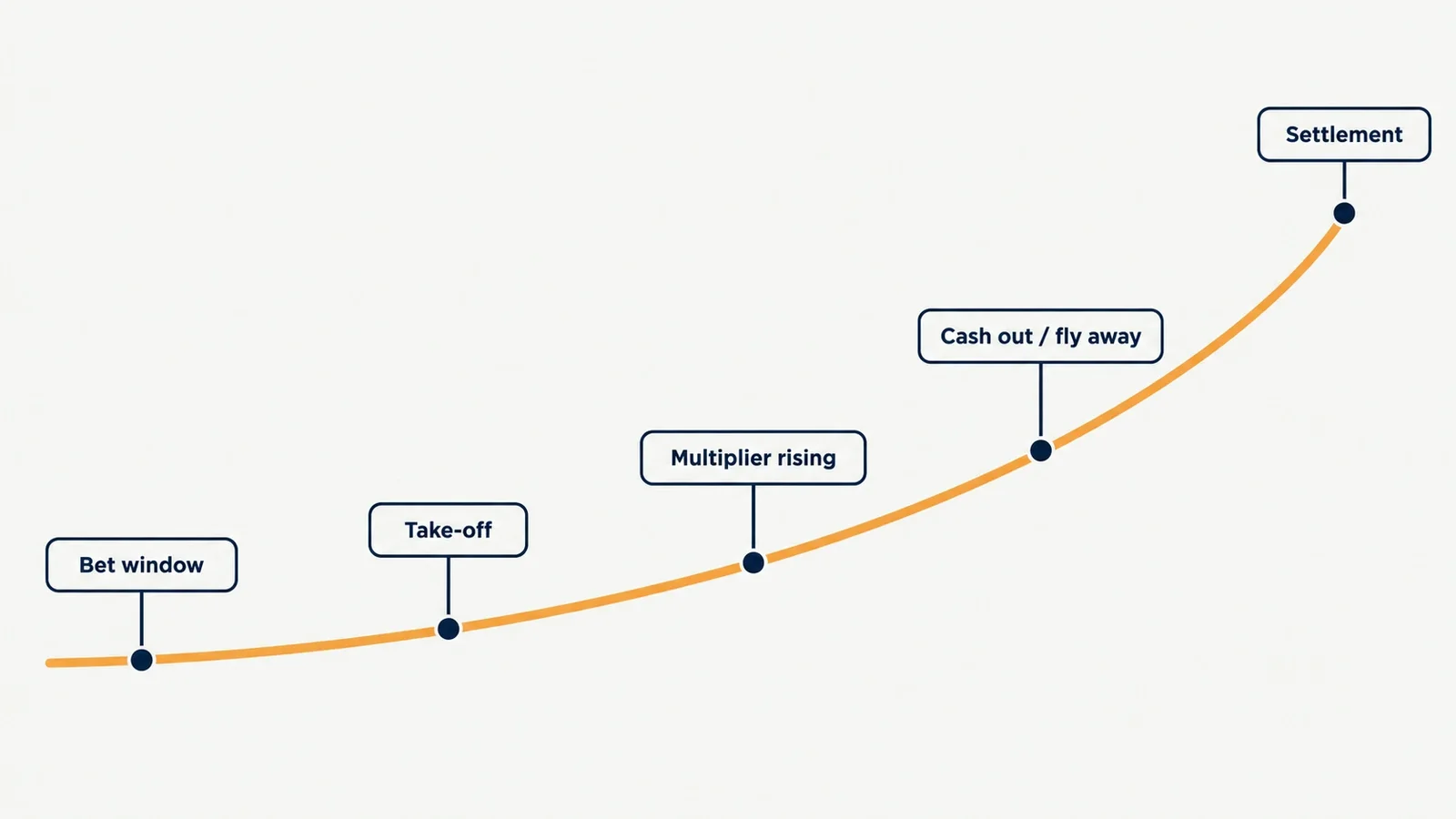 One round, five stages. The crash point is already fixed by the time stage two begins.
A round in Aviator takes between eight and twenty seconds, start to finish. Here is what happens in that time.
Bet window. A countdown of about five seconds runs between rounds. During it you set a stake, optionally set an auto cash-out value, and press bet. In Aviator you can place two bets; in JetX three; in Spaceman one. Miss the window and your bet queues for the next round.
Take-off. The multiplier appears at 1.00x. By now the game has already computed the crash point from seeds generated before anyone bet. It knows the answer and is playing it back to you.
Multiplier rising. The curve is exponential, not linear. Spribe's implementation roughly doubles the multiplier every few seconds, so 1x to 2x takes longer on the clock than 2x to 4x. This is why the game feels calm at the bottom and frantic at the top.
Cash out or fly away. Press the button, or let your auto cash-out trigger, and your stake times the multiplier at that millisecond is locked. If the crash point arrives first, every open bet in the round loses. Both outcomes can happen in the same round for different players, which is the point of the live panel.
Settlement. Winnings land in your balance instantly. The round goes into the history strip with its final multiplier, the seeds and hash become visible in the fairness panel, and the next countdown begins.
Where the crash point comes from
This is the section that matters, because it answers both "is it rigged?" and "can an app predict it?" in one go.
Modern crash games are provably fair. That phrase gets thrown around, so here is what it means in Aviator specifically.
- Server seed. Before the round, Spribe's server generates a random string. It is secret during the round.
- Client seeds. The first three players to place a bet each contribute a seed from their own device. Spribe does this so that the server alone cannot determine the outcome: it needs inputs it did not control.
- The hash. The server seed and the three client seeds are joined into one string and run through SHA-512, a one-way hash function. The output is a 128-character hexadecimal string. That hash is what becomes the round's multiplier, through a fixed formula.
- Publication. The hash of the server seed is shown before the plane moves. After the round, the full server seed and all three client seeds are revealed in the round details, so anyone can redo the maths.
The key property of a one-way hash is that you cannot run it backwards. Knowing the published hash tells you nothing about the seed, and therefore nothing about the multiplier. But once the seed is revealed you can confirm the hash matches, which proves the operator did not swap the result after bets closed.
A worked example of verifying a round
Open any finished round in Aviator and click the small shield or "fairness" icon. You will see something like this (these are made-up values in the right format):
- Server seed:
a7f3c9e1d2b84f60c5e7a9b3d1f2c4e6 - Client seeds:
k3Ld9Qz1,P0wX2nRt,Mv7Cq4Ab - Combined SHA-512 hash:
4ba348f69e8a621f32ba9334e66c9662... - Result:
1.37x
To check it, paste the four seeds, joined in that order with no spaces, into any SHA-512 calculator (there are dozens online, or run sha512sum on a laptop). The output should begin 4ba348f69e8a62. If it does, the seeds shown are the seeds used. The first 13 hex characters, 4ba348f69e8a6, convert to the decimal number 1,330,634,813,991,078. Divide that by 16 to the power of 13 and you get 0.2955, a fraction between 0 and 1. Feed it into the game's curve formula (in the standard model, multiplier = 0.97 / (1 - fraction), floored to two decimals, with a minimum of 1.00) and you get 1.37x. The same number the game paid.
You will never need to do this twice. Doing it once is useful, because afterwards you stop wondering whether the operator saw your 5,000 stake and pulled the plane early.
Stake's original Crash uses a pre-generated hash chain instead, with the same property. We walk through both in are crash games rigged?.
RTP and house edge: 97% explained with numbers
RTP, return to player, is the share of all money staked that comes back to players over a very large number of rounds. Aviator's is 97%. JetX and most classic multiplier games match it. Chicken Road is 98%, Stake's originals are 99%, Spaceman is 96.5%. The house edge is simply 100 minus RTP.
How does a crash game enforce a 3% edge when you decide when to cash out? Two mechanisms, both visible in the formula above. Roughly 3% of rounds crash at exactly 1.00x, before anyone can press anything. And the curve itself is scaled by 0.97, so the plane reaches any given multiplier slightly less often than a fair game would require.
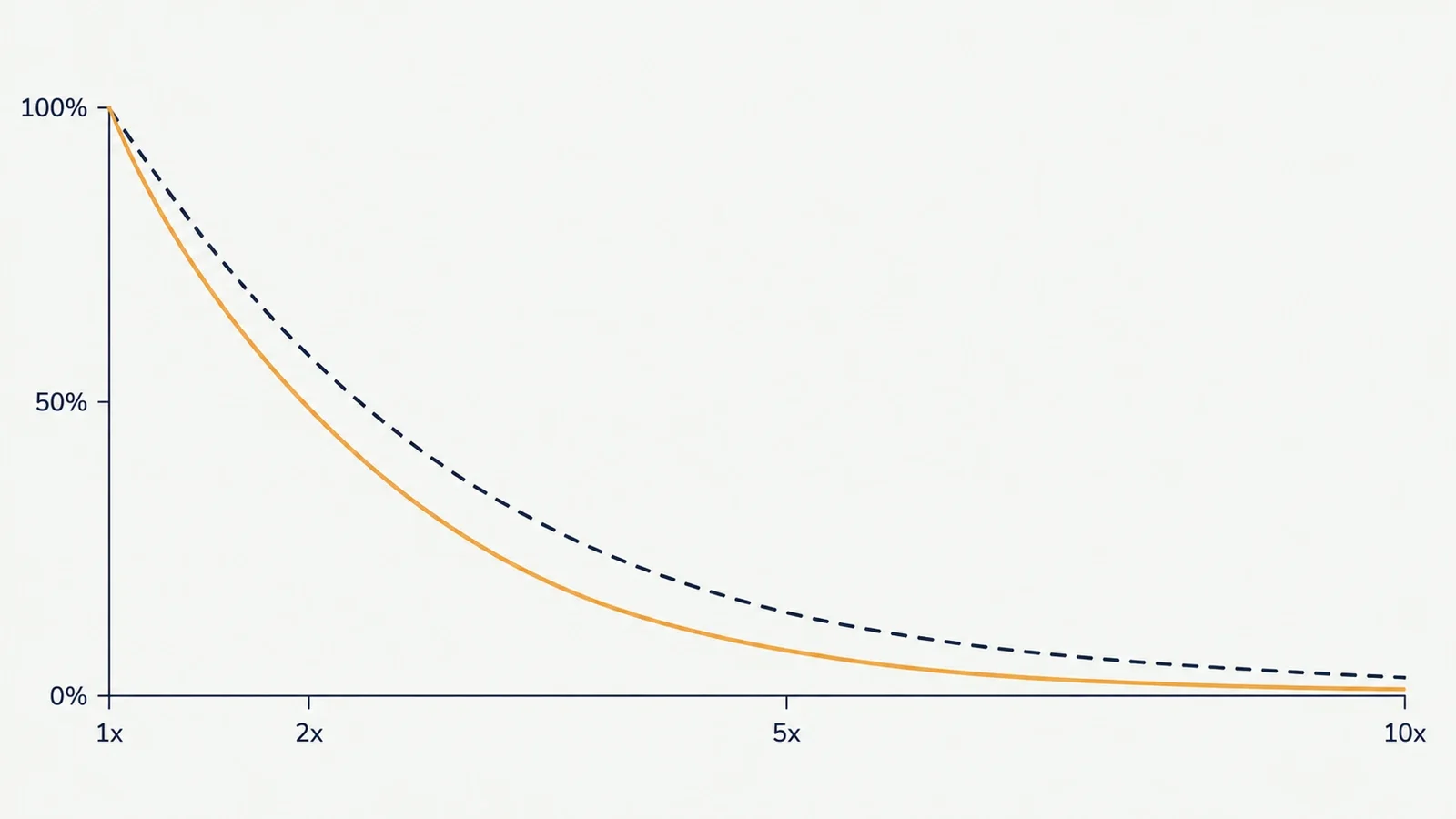 The solid line is what you get. The dashed line is what break-even would look like. The gap between them is the house edge, and it is proportionally the same all the way along.
Put into a table, with the chance the plane reaches a target against the hit rate you would need to break even at that target:
| Target multiplier | Chance of reaching it (approx. 0.97 / m) | Break-even hit rate (1 / m) | Expected result per 100 staked |
|---|---|---|---|
| 1.10x | 88.2% | 90.9% | -3 |
| 1.50x | 64.7% | 66.7% | -3 |
| 2.00x | 48.5% | 50.0% | -3 |
| 3.00x | 32.3% | 33.3% | -3 |
| 5.00x | 19.4% | 20.0% | -3 |
| 10.00x | 9.7% | 10.0% | -3 |
| 50.00x | 1.94% | 2.0% | -3 |
| 100x | 0.97% | 1.0% | -3 |
The last column is the one to stare at. It does not change. Whether you cash out at 1.10x every round like a nervous accountant or hold for 50x like someone with a story to tell, the long-run cost is 3 units per 100 staked. What changes is how the losing feels. At 1.10x you win nine rounds in ten and the 1.00x crashes eat you slowly. At 50x you lose 98 rounds in 100 and then one round pays for a week.
A practical consequence: cashing out at 1.01x is not "safe". The plane still fails to get there about 3% of the time, and those rounds cost your whole stake while the wins pay one percent. It just looks like winning for longer.
Auto cash-out, auto bet and dual bets
Three features sit under every crash game's bet panel. None of them changes the expected return. Two of them change something else that matters.
Auto cash-out lets you type a multiplier before the round. If the curve gets there, you are paid at precisely that value, no click needed. This is the one feature we would call essential. Reaction time at the button is 200 to 300 milliseconds for most people, and above 2x the multiplier moves several hundredths in that time. On a 4G connection in Lahore or Dhaka add latency on top. Manual cash-out at a "2x" target in practice pays out at 2.07x on good rounds and loses on rounds that crashed at 2.03x while your tap was in transit. Auto cash-out removes that leak entirely.
Auto bet repeats the same stake every round until you stop it or hit a limit you set. Combined with auto cash-out you have a bot, and the games allow it because a bot still pays the same 3%. The useful part is the loss cap: a stop-loss you set while calm.
Dual bets (two in Aviator, three in JetX) let you run different targets in the same round, typically one cashed out at 1.50x and one riding to 3x. Players call this hedging. It is not: each bet is an independent wager with its own 3% edge, so two bets carry twice the expected loss. What dual bets do is smooth the session, which is a variance choice, not an edge. The arithmetic is in our crash game strategy guide.
Why no app can predict the crash
Search any crash game's name and the autocomplete fills with "predictor", "hack", "signal", "AI". So it is worth saying plainly why those products cannot work, using what you now know.
The crash point is a function of a server seed nobody sees until after the round, and client seeds that are not chosen until bets are placed. The function is SHA-512, which no computer on earth can reverse. The only way to know the result in advance is to have the server seed in advance, which means being inside Spribe's infrastructure. A Telegram bot is not inside Spribe's infrastructure.
What about pattern analysis? Each round's seeds are fresh, so rounds are independent and there is no sequence to learn. A predictor that has studied ten thousand past results knows exactly as much as one that studied none.
Every predictor app we have installed turns out to be a random number generator with a cockpit interface, a login screen that harvests your casino password, or a referral funnel. Usually all three. The whole ecosystem is in crash game predictors: what they really are.
Quick start in 5 steps
If you have read this far and still want to play, this is the clean way to do it.
- Watch twenty rounds in demo mode. Spribe's Aviator demo is embedded on our game page. Count how many rounds end under 1.50x. The number will be higher than you expect, and it will recalibrate everything else you do.
- Decide a session bankroll and a stake. Pick an amount you can lose without it mattering, then bet 1% to 2% of it per round. 2,000 rupees in, 20 to 40 per bet. At that size a bad run of ten rounds is survivable.
- Set auto cash-out before the first real bet. Choose a target from the table above based on how you want the session to feel. 1.50x to 2.00x suits most people. Type it in and leave it alone.
- Set a stop-loss and a stop-win. Half the bankroll down, or the bankroll up by half: either one ends the session. Write both numbers down. The second one is the one you will be tempted to ignore.
- Play, then stop at the first limit you hit. Not the next round. Not after one more. The house edge is collected from people who keep going, and the limits only work if they are treated as rules rather than suggestions.
Bankroll basics
The maths of a crash game is not beatable, but the speed at which it beats you is up to you. Two numbers control it: how much you stake per round and how many rounds you play.
Expected loss is stake times rounds times house edge. Bet 100 per round for 300 rounds (a busy hour in Aviator) and your expected loss is 100 x 300 x 0.03 = 900. Bet 20 per round and it is 180. Same game, same odds, five times cheaper. That is the whole argument for small stakes.
Variance is the other half. At a 2x target you win about 48.5% of rounds, so five losses in a row happen every few minutes and ten in a row roughly once every 760 rounds. At 10% stakes the ten-run ends you. At 1% you shrug. Flat staking is not a strategy for winning; it is a strategy for deciding when to stop rather than having the decision made for you.
One more thing: the live bets panel shows a player cashing out 80,000 at 23x because it exists to show you that. It does not show the four hundred people who lost at 1.00x in the previous half hour. If it starts affecting your stake, collapse it.
If gambling has stopped being fun, or you are playing to win money back, that is the time to stop and talk to someone. Helplines for every country we cover are on our responsible gambling page. 18+ only.
Frequently asked questions
What is a crash game?
A crash game is a casino game where a multiplier rises from 1.00x and stops at a random point. You bet before the round, cash out at any moment while it climbs, and are paid your stake times the multiplier at that instant. If the round crashes before you cash out, you lose the stake. Aviator, JetX, Spaceman and Stake Crash are all crash games.
How is the crash point decided?
Before the round starts, the server generates a secret seed and publishes its hash. Player seeds (in Aviator, from the first three bettors) are added, the combination is hashed with SHA-512, and the hash is converted into a number that becomes the multiplier. Because the hash was published first, the operator cannot change the result after bets are placed.
What does 97% RTP mean in a crash game?
Over a very large number of rounds, 97 units come back to players for every 100 staked. In practice, about 3% of rounds crash instantly at 1.00x and the rest follow a curve where the chance of reaching a multiplier m is roughly 0.97 divided by m. The 3% gap between that and break-even is the house edge, and it is the same at every target.
Can previous rounds help predict the next one?
No. Each round uses a fresh server seed and a new combination of player seeds, so the results are independent. Five rounds under 1.50x in a row say nothing about the sixth. The history strip at the top of the game is there because people like looking at it, not because it carries information.
Is auto cash-out better than clicking manually?
It is better in one measurable way: it removes reaction time. Human reaction at the cash-out button is around a quarter of a second, and the curve moves fast above 2x. Auto cash-out pays exactly at the target you set. It does not change the expected return, which is set by the RTP, but it stops you giving away money through late clicks.
Is there a best multiplier to cash out at?
Not in terms of expected value. At 1.20x, 2x, 5x or 50x the house keeps the same 3% on average. What changes is variance. Low targets lose slowly with frequent small wins, high targets lose in long droughts with rare big wins. Pick a target you can sit through emotionally, set auto cash-out to it, and keep stakes small.
Which crash game has the highest RTP?
Among widely available titles, Evolution's live Cash or Crash lists 99.59%, Stake's Limbo and Crash originals run at 99%, Chicken Road is 98%, and Aviator, JetX and most classic multiplier games are 97%. Spaceman is 96.5%. A higher RTP is a smaller edge, not a profitable game.
Daniel Reyes
Daniel has written about online casino games since 2016 and has been playing crash games since the first Bustabit era. He owns the editorial standards on this site and signs off every global page.